
THE BENEFITS OF USING SHORTER CRANK ARMS
First of all, it’s worth mentioning that cycling is a repetitive sport. Based on a simple logic, the more you make these repetitive movements easier and less costly for the body, it adds up drop by drop like water filling a lake, leading to a significant overall gain. Shortening your crank arm length essentially makes your pedaling motion easier, and as a result, provides you with some direct and indirect advantages.
The most obvious of these advantages is an increase in your cadence, provided that your gear ratio remains the same.
We can explain it like this:
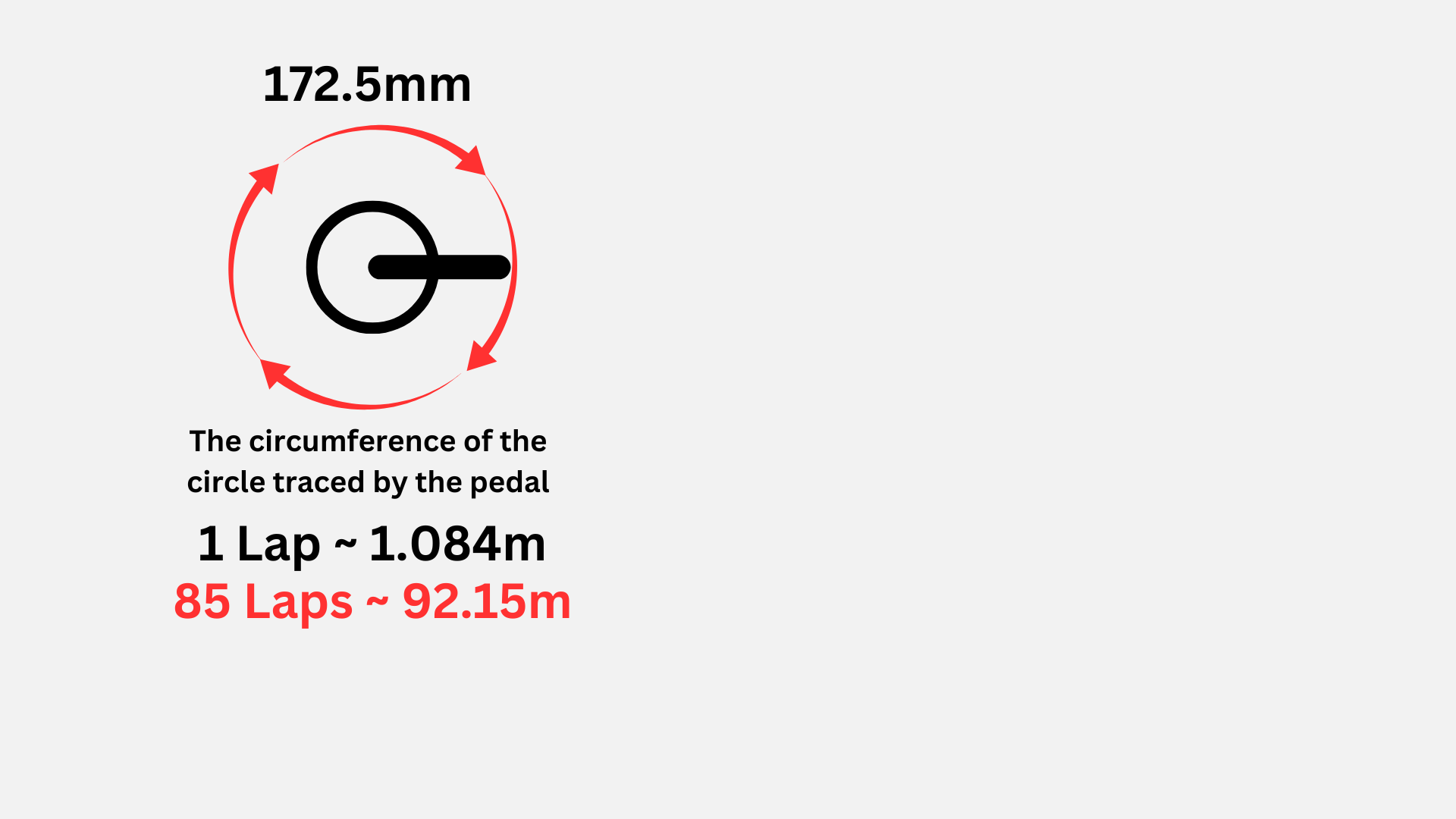
If you pedal with a crank length of 172.5 mm at 85 rpm (cadence), your foot travels 92.15 meters in one minute.
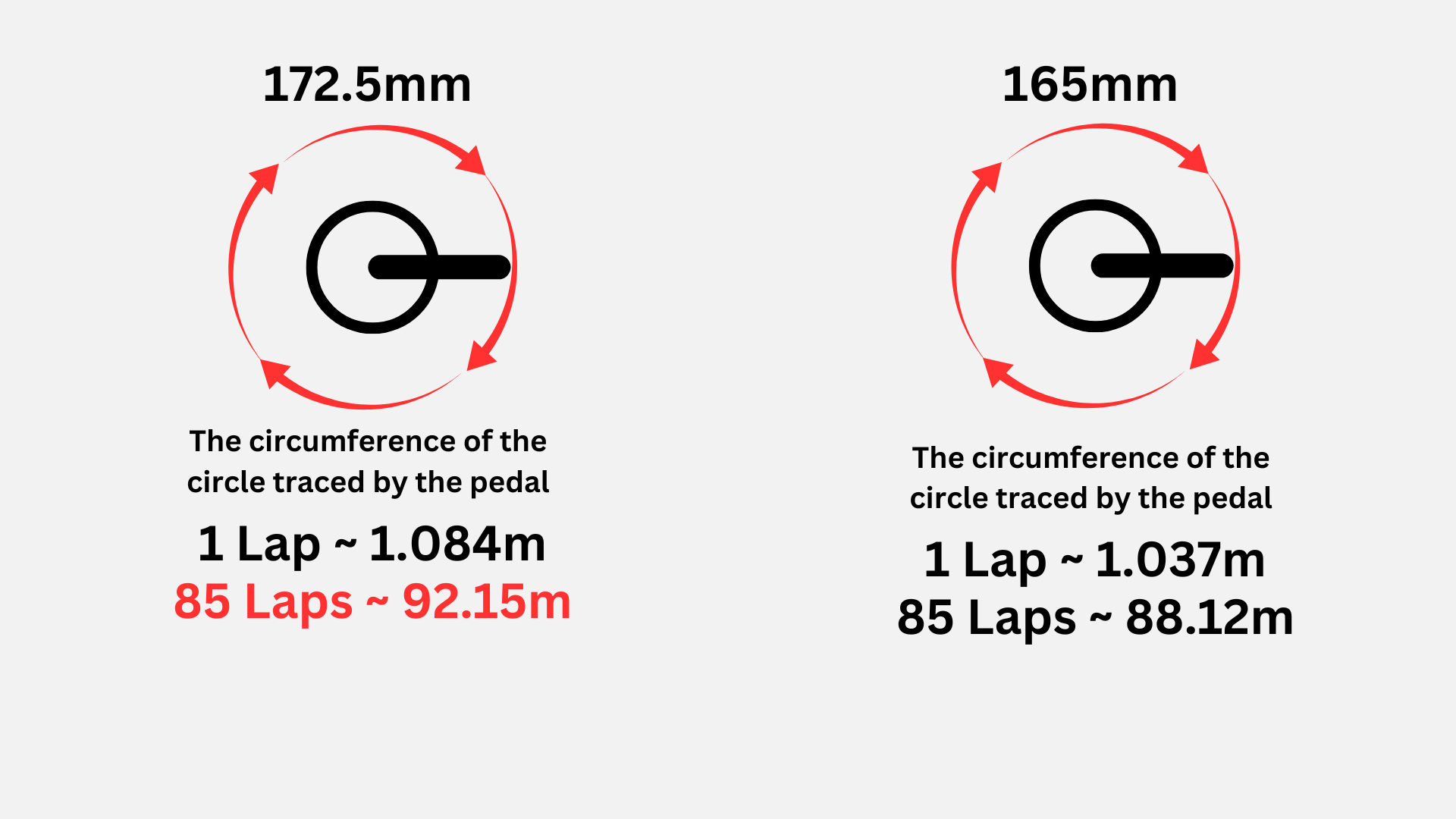
If you pedal with a crank length of 165 mm at 85 rpm, your foot travels 88.12 meters in one minute. So, with a shorter crank arm, your foot covers approximately 4 meters less distance.
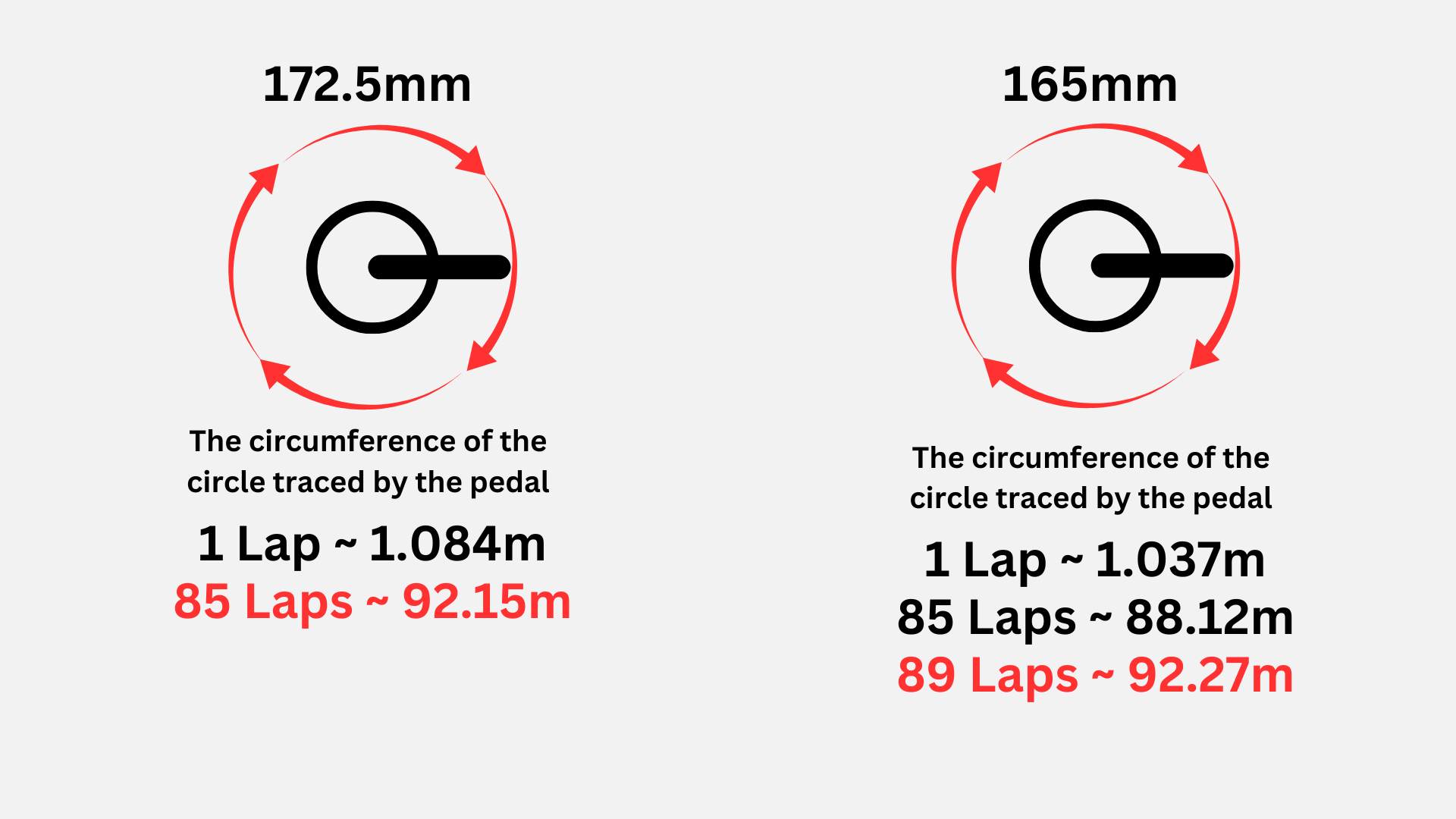
Therefore, when switching to a 165 mm crank arm, in order to cover this 4-meter difference, you need to pedal at 89 rpm instead of 85.
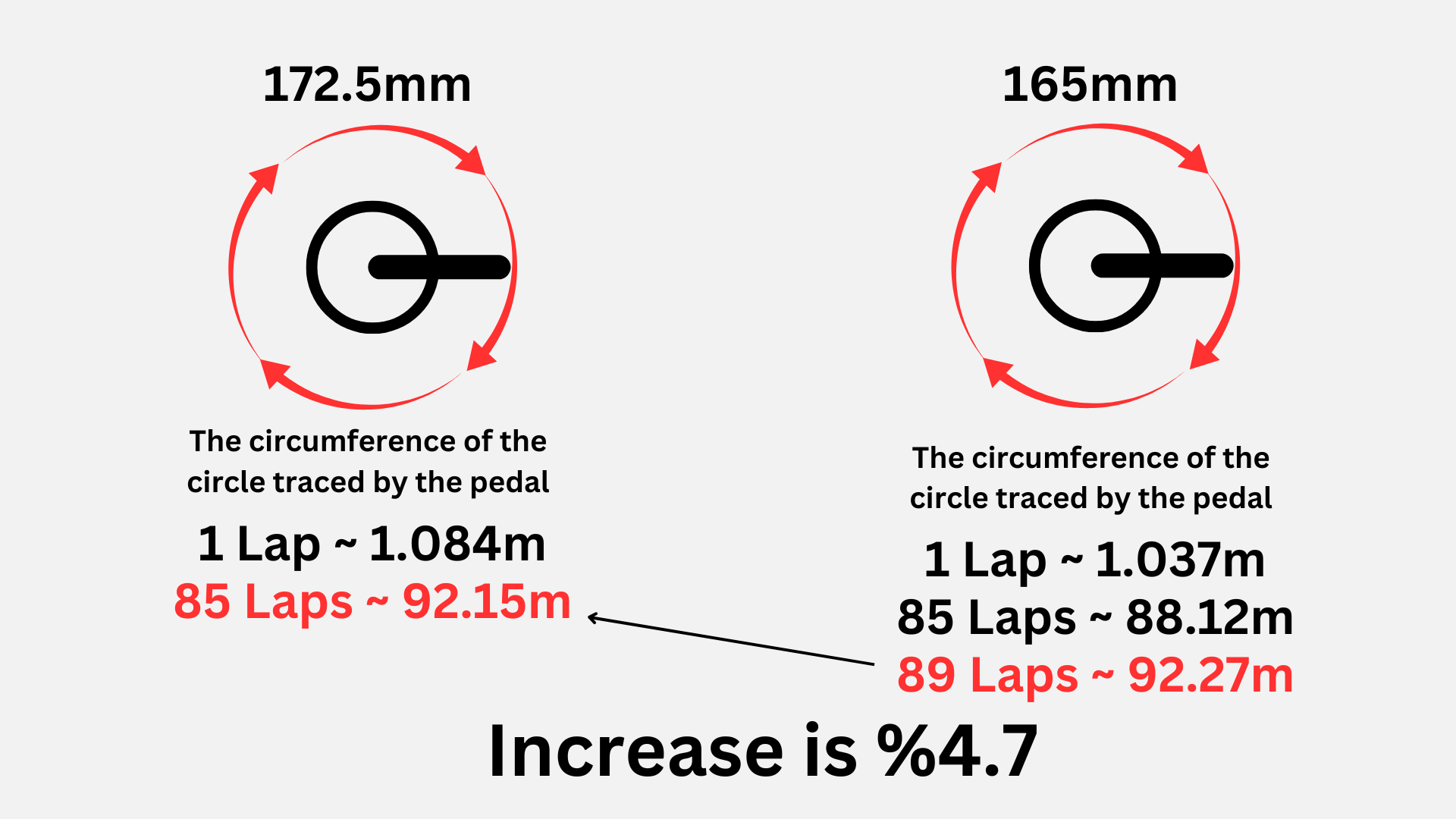
In other words, your cadence increases by 4.7% so that your foot can travel the same distance in one minute.
I’m aware this includes a bit too much math, but this is the clearest way to explain why your cadence will increase.
So what happens when cadence increases?
The formula for power is torque × cadence.

Since we’ve increased cadence, the torque we need for the same power output and therefore the force we need to apply to the pedal to generate that torque will decrease.
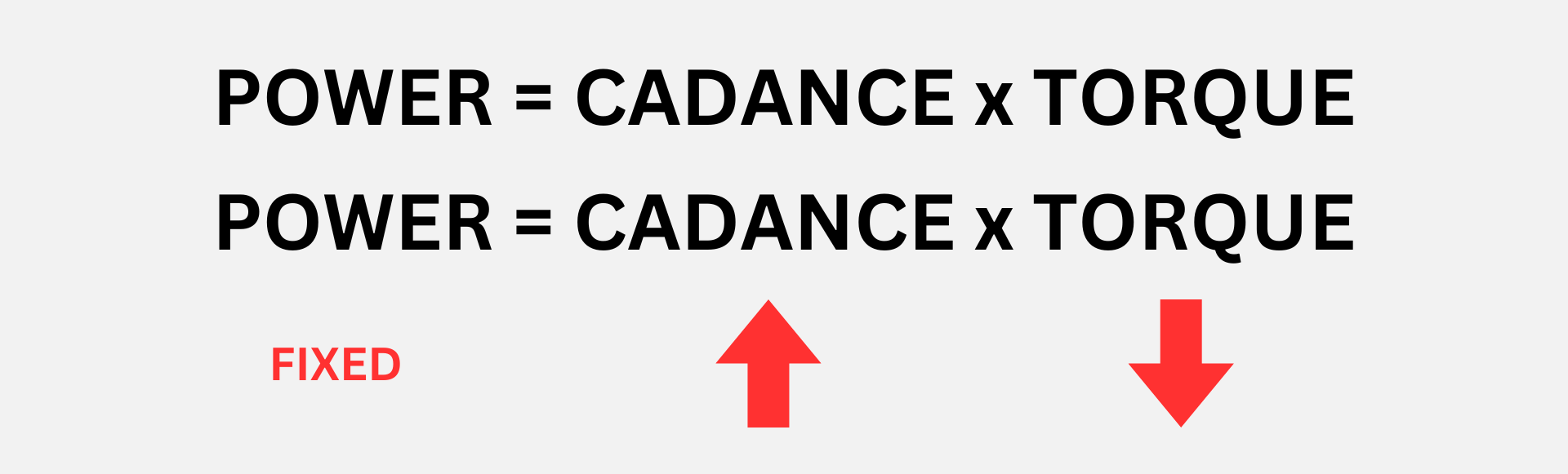
To those who say, “But if the crank arm gets shorter, the lever arm gets shorter, so shouldn’t the force increase?” — here’s the clarification:
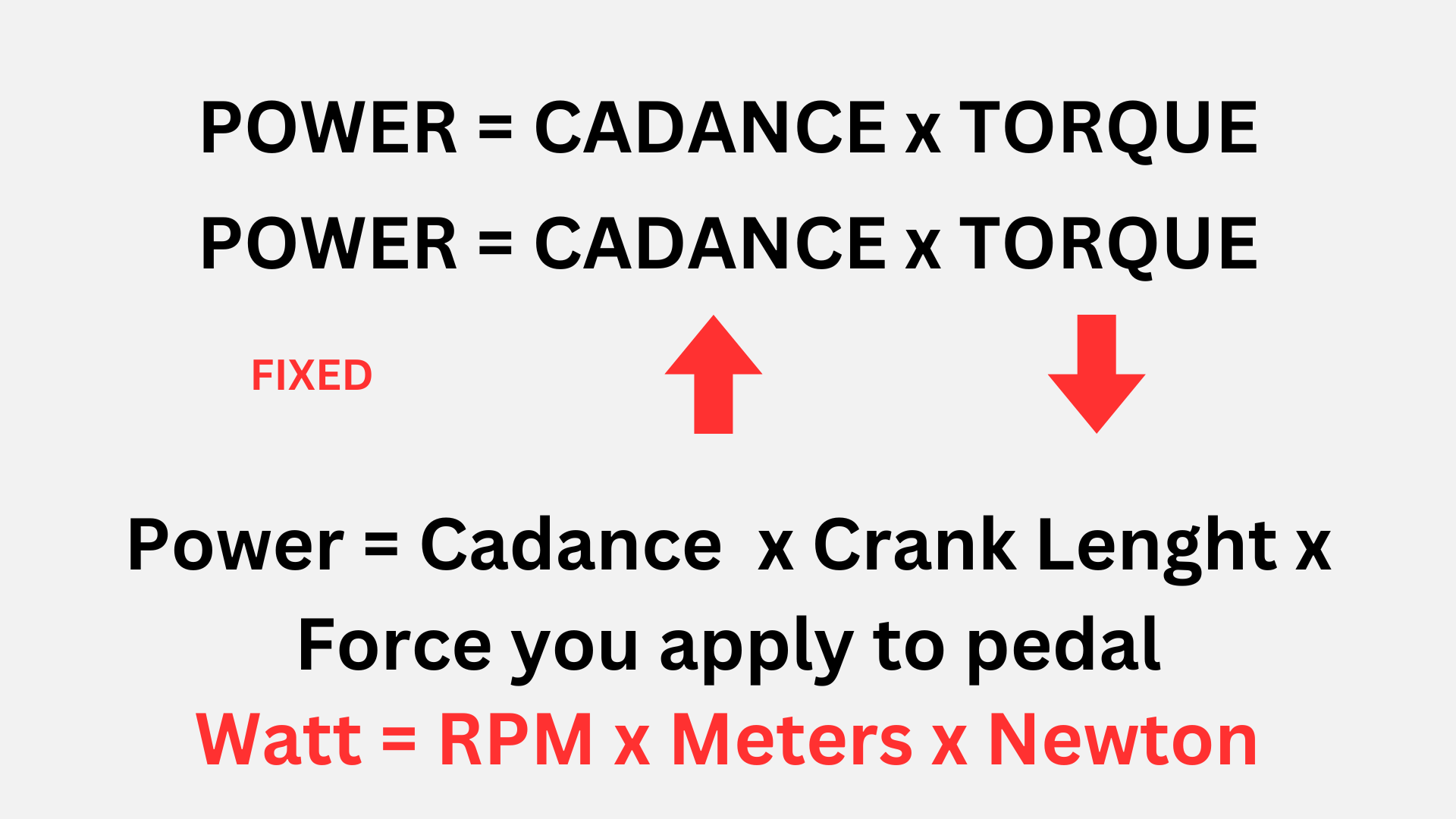
7.5 mm equals 0.075 meters.
If we open the formula as:
W = cadence × crank length × force,
A 5-unit increase in cadence vs. a 0.075 m decrease in crank length creates a negligible difference that cannot be overlooked.
Let’s continue from where we left off.
In this case, the muscles working with less load will experience less wear and, naturally, you will feel less fatigued.
But when crank length is shortened and cadence increases, doesn’t this have any negative effects on us?
In general, I can say clearly that a 4-5 unit increase in cadence doesn’t impose any additional metabolic load on the body.
However, during the adaptation period, you might feel a bit different.
After cadence, you might think it’s necessary to discuss the effects of shorter crank arms on power and speed, but before doing that, it’s useful to explain their effects on your position and efficiency on the bike.
Because improvements in your position directly affect your power production and speed.
Let’s continue with position then:
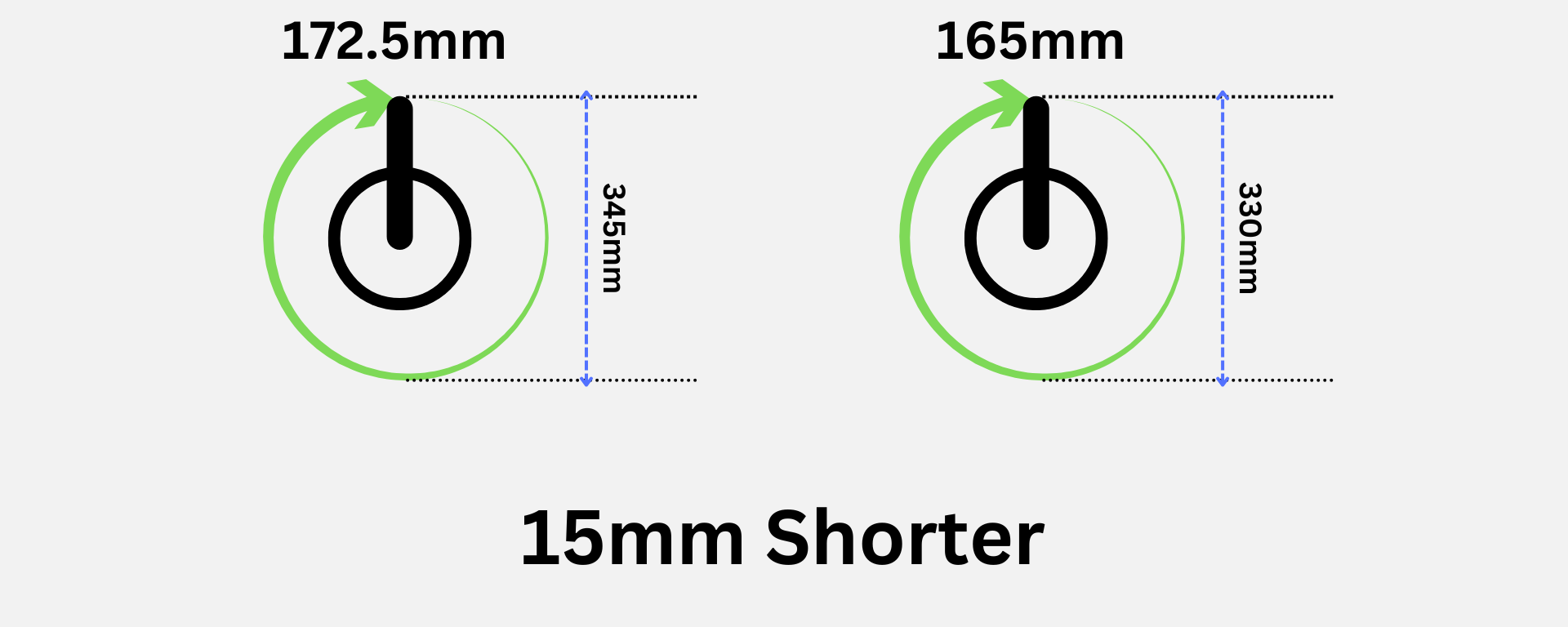
When you reduce your crank length from 172.5 mm to 165 mm, your knee begins to move on a path that is 15 mm shorter between the 6 o'clock and 12 o'clock pedal positions.
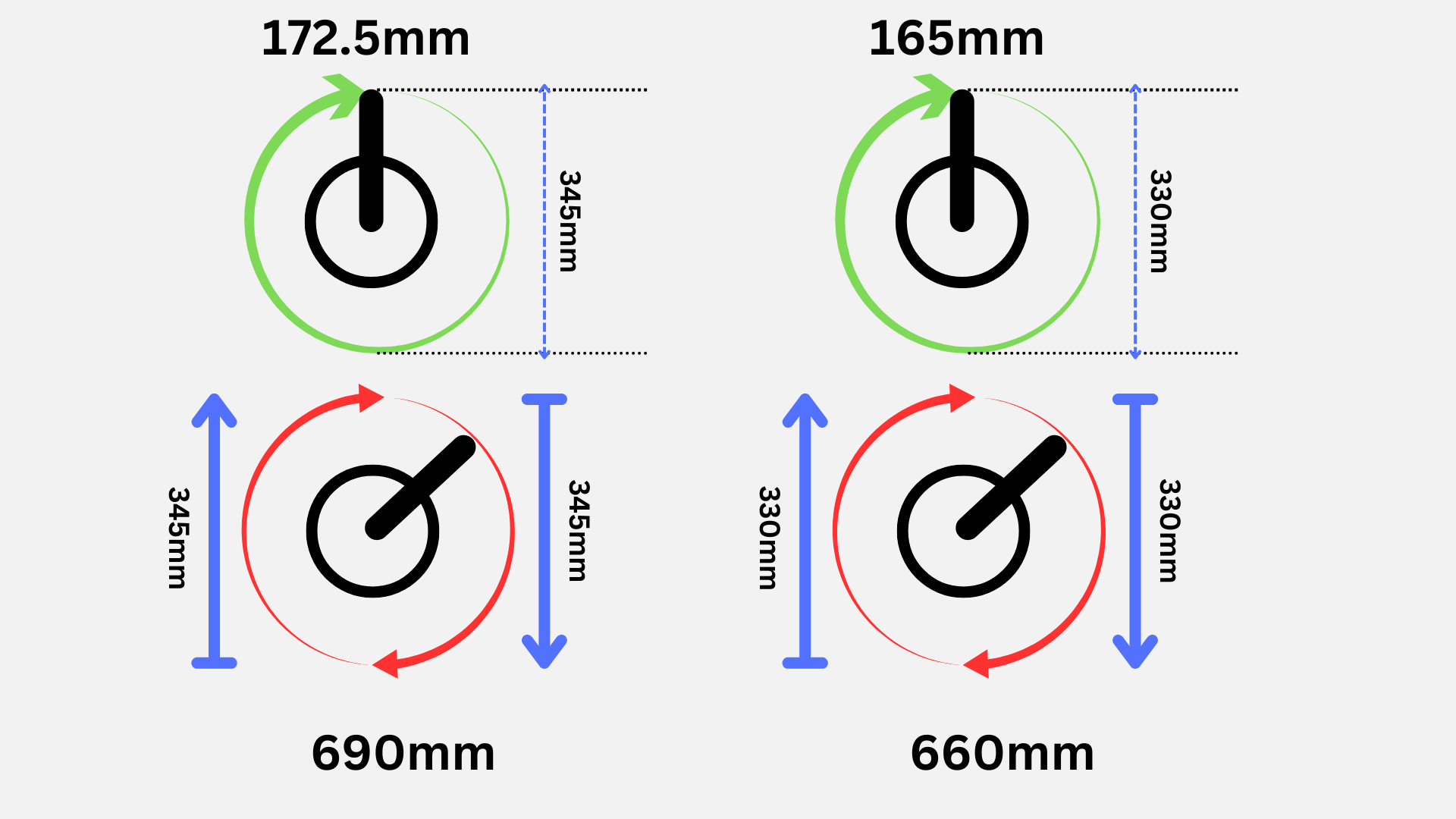
To go into more detail: when you complete a full pedal rotation, your foot travels 660 mm on a vertical line instead of 690 mm.
So in the same amount of time (one full pedal rotation), your knee and the muscles that move it contract and relax more slowly because they are covering a shorter distance. In this case, slower-contracting and relaxing Type A muscle fibers come into play, which are superior in terms of endurance. Yes, your cadence increases and you use your muscles more, but because you use them over shorter distances and at slower contraction/relaxation speeds, your efficiency improves. Additionally, slower-contracting muscles can generate more force. More force means more power.
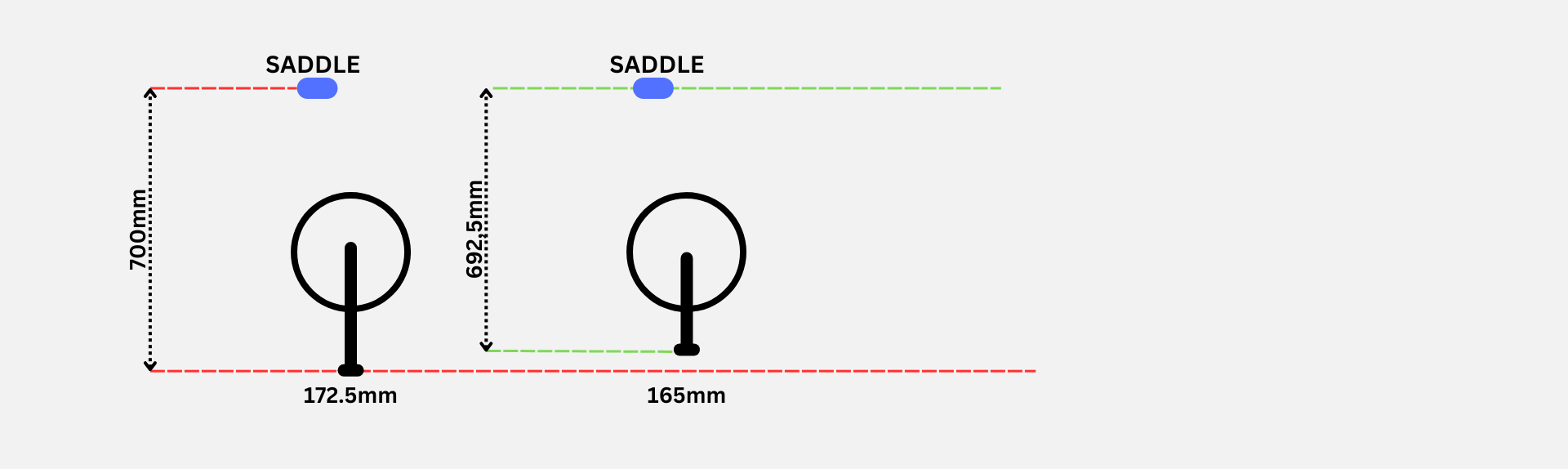
Geometrically, if you reduce your crank arm from 172.5 mm to 165 mm, your foot will now be 7.5 mm higher at the 6 o’clock position of the pedal.
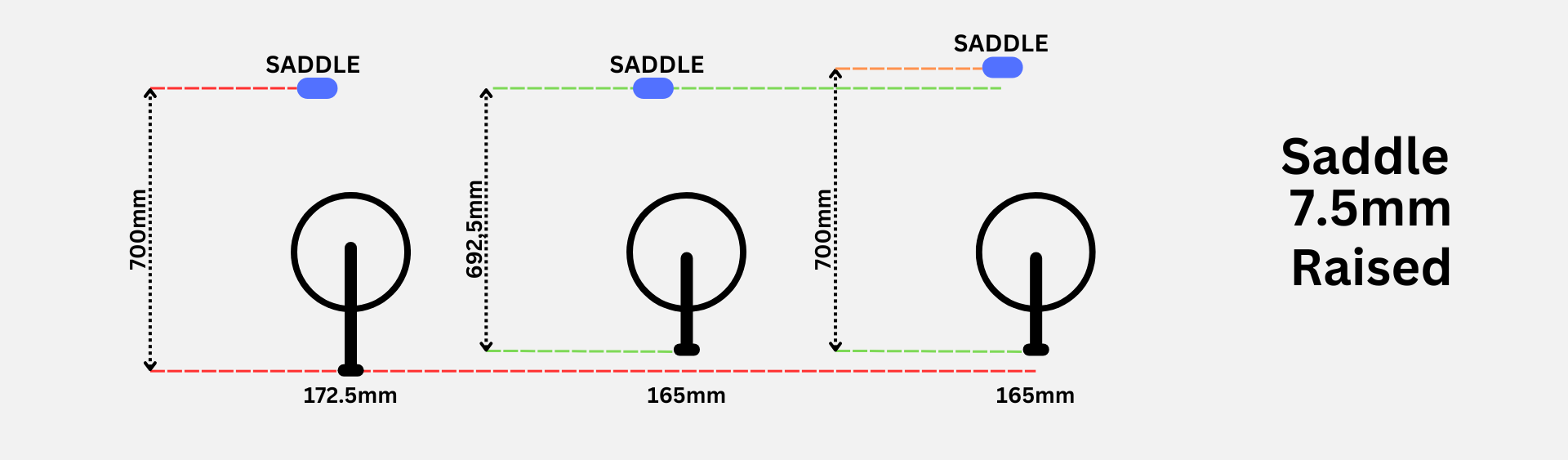
To balance this and return your saddle setting to normal, you also need to raise your saddle by 7.5 mm
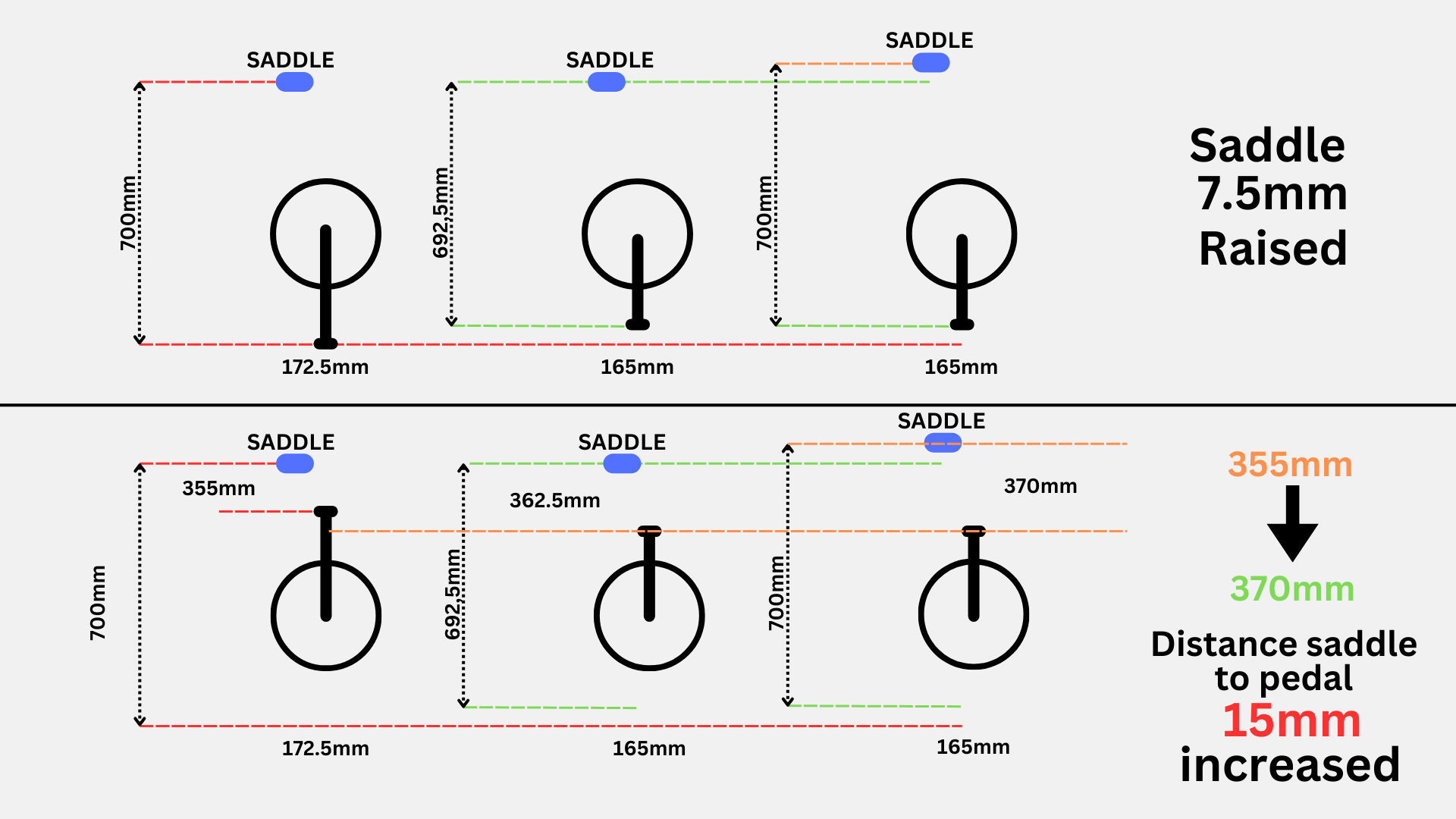
When you do this, at the 12 o’clock pedal position, the distance between your knee and the saddle will be 15 mm greater than before.
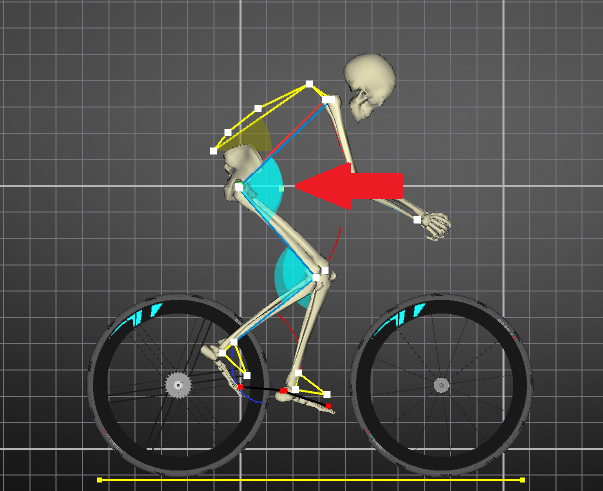
Thus, the hip range of motion between your upper leg and torso increases.
This expanded range of motion can provide many advantages in terms of comfort, balance, efficiency, stability, aerodynamics, and performance.
Now, I’d like to touch on these points one by one.
Let’s start here: most of the cyclists watching this video are likely people who ride an average of 2-3 times a week, work desk jobs, and most probably don’t have very flexible bodies.
Therefore, all applications that increase hip range of motion on the bike for example, raising or moving the handlebar closer, moving the saddle forward noticeably increase comfort.
But these changes, while improving comfort, may come with biomechanical or aerodynamic disadvantages and even increase injury risk unlike shortening the crank arm, whose biggest disadvantage is probably just the cost.
Now let me explain how shortening the crank arm positively affects comfort:
As I mentioned, most of us lack adequate muscle flexibility. Therefore, regardless of what kind of bike you use (but especially on road bikes), when you pull the pedal upward, the muscles around the pelvis which lack flexibility cause the pelvis to rotate backward on the saddle.
This can lead to saddle discomfort and lower back problems, and later, as your reach and bending ability are restricted, it may cause complaints in the shoulders, neck, arms, elbows, and hands. If you still experience such discomfort even after setting the saddle correctly, adjusting handlebar height and reach, then shortening your crank arm by at least 5 or 7.5 mm will help open your hip range of motion.
This allows your pelvis to rotate forward as it should, helping you sit more comfortably. As a result, your spine curvature will take on a more natural form. With reduced reach demands, your shoulders and neck will relax. And because your body weight is more evenly distributed, your hands, wrists, and elbows will feel more comfortable. These are the benefits on the comfort and balance side.
Additionally, at the point where you pull your knee up (12 o’clock pedal position), the inner side of your hip will be less compressed, meaning your body will try to push upward less. This reduced upward pressure significantly lessens the side-to-side rocking of the pelvis while pedaling.
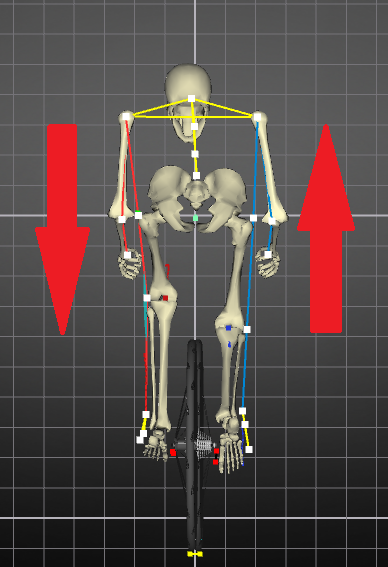
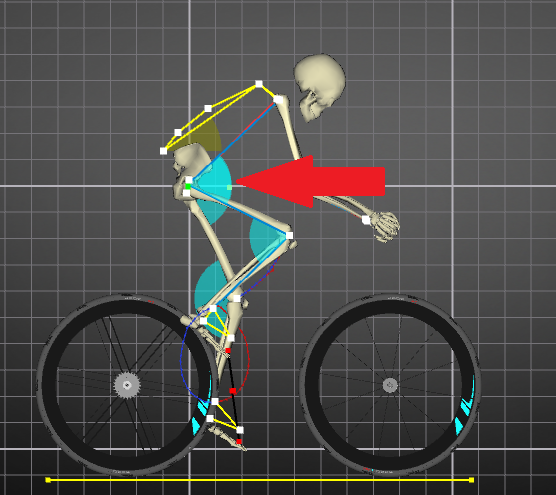
As your knee’s movement area expands at the 12 o’clock position and you pedal over a shorter distance than before, the need for lateral movement also decreases, and your leg starts to move in a straighter line.
This reduces the risk of knee pain and injury, and a more stable and less oscillating movement of the knees and hips reduces the load on the muscles trying to keep your body steady. That means energy savings and improved efficiency.
Also, with less hip compression, your internal organs aren’t pushed upward as much, your diaphragm works more freely, and your breathing becomes easier.
Finally, with the relaxation of your back, shoulders, and arms, your head drops into a lower position, providing even amateur cyclists with an aerodynamic advantage.
Now, let’s say you are a more advanced athlete, regularly working on flexibility and strength, spending longer hours cycling and training.
In that case, when you shorten your crank from 172.5 mm to 165 mm, how can you gain additional advantages on top of all the comfort, stability, energy savings, efficiency, and new muscle recruitment?
Assuming that you are flexible enough and that your core and upper body are strong enough, you can use this expanded range of motion to lower your handlebars. In this case, your back will become more parallel to the ground, and since your frontal area is reduced, you will be in a more aerodynamic position.
As a result of all this, if you are riding in a more comfortable, more efficient, more aerodynamic, more balanced, and more stable position, you will be able to generate more or more effective power and go faster. So although a shorter crank arm may not seem to help you produce more power mechanically, in the end, it helps you generate more power and go faster.
So how much should you shorten it? Can any crank arm length fit everyone? Wouldn't it be funny if a 195 cm tall person used a 165 mm crank arm?
First of all, you should know this: a 2.5 mm reduction may not give you any of the advantages I mentioned in a noticeable way. To create noticeable and tangible differences, you need at least a 5 or 7.5 mm change.
To give a general measurement, riders between 170 cm and 190 cm in height can all use crank arms as short as 165 mm in a healthy and efficient way. You don't have to use a 175 mm crank arm just because you're 190 cm tall.
If your saddle height is between 65 and 70 cm, my recommendation would be to use a 165 mm crank arm.
If your saddle height is below 65 cm and your height is also under 165 cm, your preference should be 160 mm or 155 mm crank arms.
If you ride on long distances at a pace close to steady in short, if you're a triathlete, you can switch to shorter crank arms.
If you're struggling to produce power and quickly get tired during fast, high-power rides, you can switch to shorter crank arms.
If, even after adjusting your cleats, selecting and adjusting your saddle, and setting your handlebar distance and height, you still experience issues with your saddle area, lower back, shoulders, neck, back, hands, or wrists, you can switch to shorter crank arms.
Are there really no disadvantages despite all these advantages?
Even though they may be considered minimal compared to the benefits, there are some drawbacks.
If you are already riding at relatively high average cadences like 95-100 rpm or above, the additional increase in cadence may physically challenge you. Your heart rate might rise more than expected, which could prevent you from maintaining a steady tempo for a long time.
On the other hand, since you need to pedal at a higher cadence to produce the same amount of power, especially in races like criteriums where short bursts of power are crucial, the time it takes to reach that high cadence may make you feel slower. In short, your ability to generate power instantly could be slightly delayed by fractions of a second.
If your body isn't well-balanced and strong enough to handle the increased cadence, you might feel like you're bouncing or unstable until you adapt or find the right gear ratios for your new setup.